


Giottus data story: How South India is redefining crypto adoption
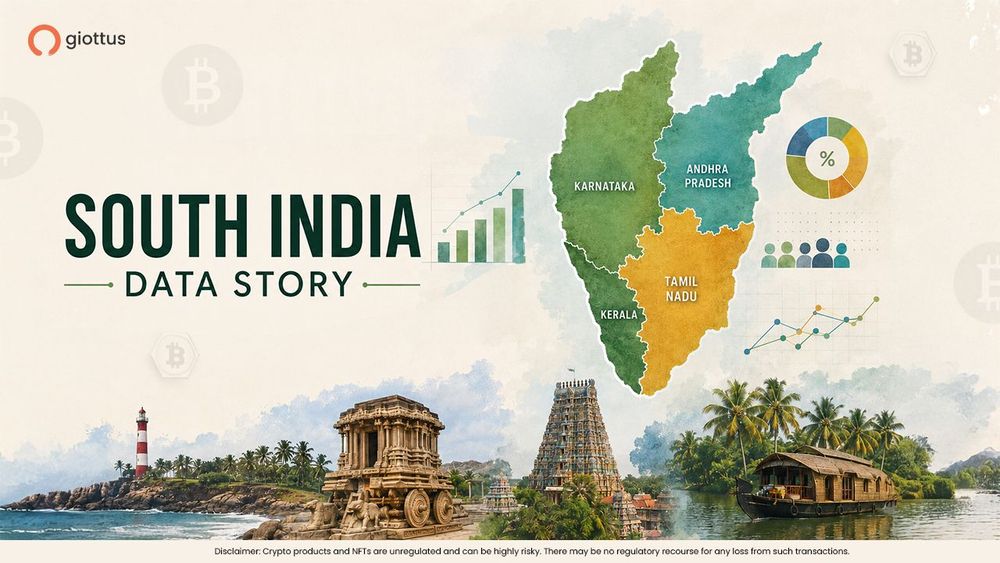
What if India’s crypto growth story has very little to do with income?
Giottus analysed trading behaviour, participation trends, and user activity across five major South Indian states in 2025. The results revealed a surprising pattern. Higher income did not automatically lead to stronger crypto adoption.
Instead, the biggest drivers were urbanisation, digital familiarity, and risk appetite.
The data shows that South India’s crypto story is becoming deeply behavioural and city-driven, with each state developing its own unique relationship with digital assets.
South India’s crypto story is not just about income
Most people assume that higher income automatically leads to higher crypto participation. But Giottus’ 2025 trading data across South India tells a very different story.
After analysing user behaviour across Tamil Nadu, Kerala, Karnataka, Andhra Pradesh, and Telangana, one trend stood out clearly. Income had little to do with crypto activity. Urbanisation and digital familiarity played a much bigger role.
This changes how we should look at crypto adoption in India. The market is not growing only among wealthy users. It is growing faster among digitally connected users who are comfortable with online payments, fintech apps, and new investment products.
The big surprise: Telangana
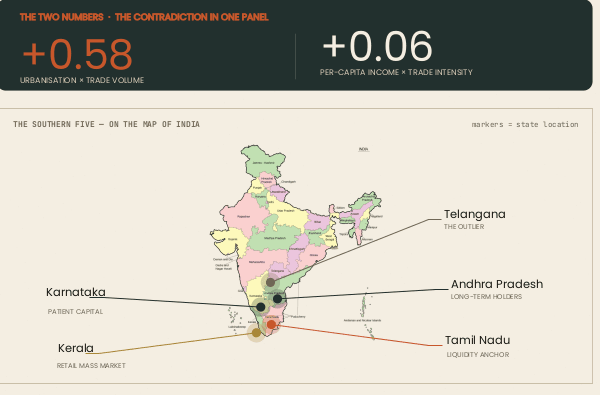
Telangana was the biggest outlier in the study.
Despite having the highest per capita income among the five southern states, Telangana recorded the lowest trader participation and the weakest trading activity.
This suggests that income alone does not drive crypto adoption. Access, digital culture, and risk appetite matter much more.
People need familiarity with technology and online finance before they feel comfortable entering crypto markets.
Tamil Nadu leads the South
Tamil Nadu emerged as the strongest crypto market in South India.
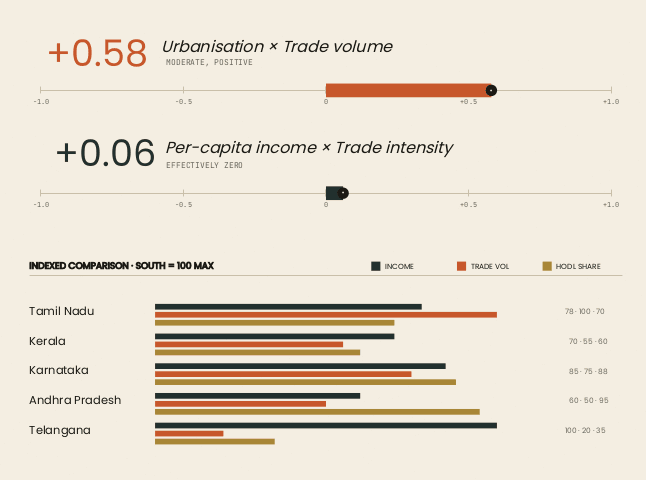
The state ranked first in both trader count and total trade volume. More importantly, over 80% of users in Tamil Nadu were active traders instead of passive holders.
This shows a market that is highly comfortable with volatility, active trading, and frequent portfolio movement.
Tamil Nadu is currently the centre of crypto trading activity in the South.
Kerala’s retail participation story
Kerala showed a different type of crypto participation.
The state had one of the highest active participation ratios, with 82% of users actively trading instead of simply holding assets. Crypto activity in Kerala appears more community-driven and accessible at the retail level.
Instead of large high-risk trades, participation is spread across a wider user base.
This reflects how crypto is slowly becoming a mainstream digital investment habit among everyday users.
Karnataka’s long-term investors
Karnataka showed signs of more patient investing behaviour.
Users in the state recorded higher deposits per customer along with longer holding periods. Many investors appeared focused on building long-term positions instead of frequent trading.
This points toward a more conviction-driven investor base.
Rather than chasing short-term price movements, many Karnataka users seem to view crypto as a longer-term opportunity.
Andhra Pradesh’s strong holding behaviour
Andhra Pradesh stood out for its high long-term holding activity.
Compared to other states, investors here were less focused on short-term trading and more interested in accumulating and holding crypto assets over time.
This behaviour suggests growing confidence in crypto as a long-term store of value instead of purely speculative trading.
Why Urbanisation matters more than income
One of the strongest findings from the data was the connection between urbanisation and crypto activity.
The data showed:
Urbanisation × Trade Volume: +0.58
Income × Trade Intensity: +0.06
Cities naturally create an environment that supports digital finance. Smartphone usage is higher, digital payments are common, and people are more exposed to fintech products and investing culture.
This makes crypto adoption easier.
A young professional in a highly urbanised city may be more likely to trade crypto than someone earning much more in a less digitally connected area.
Access and exposure are becoming stronger drivers than salary levels.
Crypto adoption is becoming behavioural
The study also showed that each state is developing its own crypto personality.
Some states prefer active trading. Others show stronger long-term holding behaviour. Some are driven by retail participation, while others reflect higher conviction investing.
This is an important shift.
Crypto adoption in India is no longer limited to a small speculative audience. Different communities are building their own relationship with digital assets based on local culture, digital familiarity, and financial behaviour.
What this means for India’s crypto future
As digital infrastructure expands across more Indian cities, crypto participation could continue growing naturally.
UPI adoption, smartphone penetration, fintech awareness, and social media exposure are already preparing millions of users for digital assets.
For platforms like Giottus, future growth may come less from the highest income groups and more from digitally connected urban users.
The data also suggests that India’s crypto market may become increasingly regional, with different states showing unique participation patterns and investment behaviour.
Conclusion
South India’s crypto story is being shaped by cities, digital access, and user behaviour rather than income alone.
The data shows that adoption is increasingly being shaped by cities, digital access, familiarity with technology, and willingness to engage with new financial products.
Crypto participation in India is growing from the ground up, driven by digitally connected communities that are becoming more comfortable with modern investing and digital assets every year.
Disclaimer: Crypto products and NFTs are unregulated and can be highly risky. There may be no regulatory recourse for any loss from such transactions. Please do your own research before investing and seek independent legal/financial advice if you are unsure about the investments.
Updated on: 21st August, 2026 3:00 PM


