


INR vs USDT: Which should Indian crypto traders use? A 2026 data comparison
If you are new to crypto trading in India, one question comes up sooner or later: Should I trade using INR or USDT?
The answer isn’t as straightforward as choosing one over the other. Both have their advantages, and the right choice depends on how you trade, how often you trade, and what assets you want to access.
In 2026, Indian crypto traders have more options than ever. Exchanges now support direct INR trading for popular cryptocurrencies, while USDT remains the preferred quote currency across the global crypto market.
Understanding when to use INR and when to use USDT can help you reduce unnecessary conversions, improve trading efficiency, and manage your portfolio more effectively.
Let's compare both options.
What is INR trading?
INR trading simply means buying or selling cryptocurrencies directly using Indian Rupees.
For example:
- Buy Bitcoin with ₹5,000
- Sell Ethereum and receive INR directly in your wallet
- Deposit and withdraw funds through your Indian bank account
This is the simplest way for most first-time investors to enter the crypto market.
Since your salary, savings and daily expenses are all in INR, there is no need to convert funds into another currency before investing.
What is USDT trading?
USDT (Tether) is a stablecoin designed to closely track the value of the US Dollar.
Ideally,
1 USDT ≈ 1 USD
Unlike Bitcoin or Ethereum, USDT is intended to remain relatively stable in price.
Instead of trading Bitcoin against INR, traders often use trading pairs such as:
- BTC/USDT
- ETH/USDT
- SOL/USDT
- XRP/USDT
Globally, most cryptocurrency trading volume takes place against USDT because it provides a common pricing standard across exchanges.
INR vs USDT: A Quick Comparison
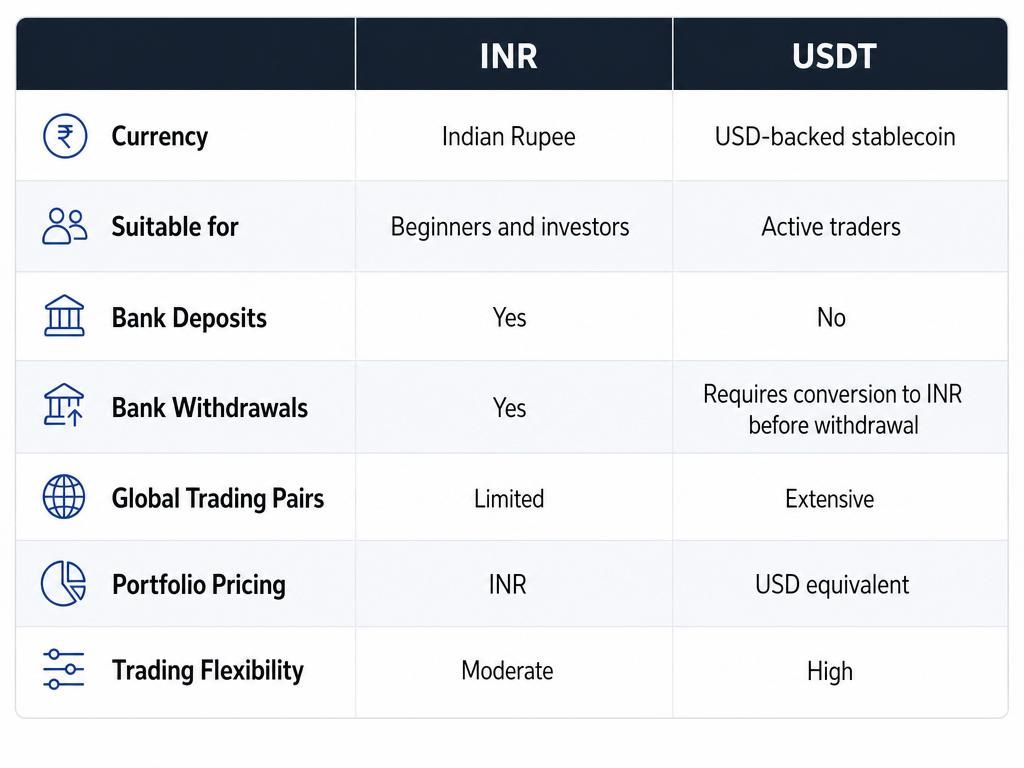
Both serve different purposes, and many experienced traders use both depending on their strategy.
When INR makes more sense
For most investors entering crypto for the first time, INR trading is usually the better starting point.
Suppose you decide to invest ₹10,000 every month in Bitcoin.
Using INR, the process is straightforward:
- Deposit ₹10,000
- Buy Bitcoin
- Hold for the long term
There are fewer steps involved, making the investment process simple and easy to understand.
This is also why Crypto SIPs are typically funded using INR.
If your goal is long-term investing rather than frequent trading, INR offers convenience without adding extra conversions.


When USDT becomes more useful
USDT is commonly used by traders who actively buy and sell cryptocurrencies.
Imagine you spot an opportunity to move quickly between Bitcoin, Solana and Ethereum during a volatile market.
Using USDT allows you to:
- Exit one position quickly.
- Hold funds in a relatively stable crypto asset.
- Enter another trade without converting back to INR each time.
For example:
You sell Bitcoin for USDT.
A few hours later, Ethereum reaches your target entry price.
Instead of withdrawing to your bank and depositing again, you can use the same USDT balance to purchase Ethereum immediately.
This flexibility is one reason why professional traders often prefer USDT pairs.
A practical example
Let's compare two investors with ₹50,000.
Investor A
- Deposits ₹50,000.
- Buys Bitcoin using INR.
- Holds the investment for three years.
This investor rarely trades and simply wants long-term exposure.
Investor B
- Deposits ₹50,000.
- Converts to USDT.
- Trades Bitcoin, Ethereum and Solana multiple times during the month.
- Keeps unused funds in USDT between trades.
The second investor benefits from quicker transitions between crypto assets without repeatedly moving money through a bank account.
Neither approach is universally better, it depends on investment style.
Liquidity matters
One important reason traders prefer USDT is liquidity. Across the global crypto market, the majority of trading volume is denominated in USDT.
Higher liquidity generally means:
- Faster order execution
- Smaller bid-ask spreads
- Better price discovery
- Easier entry and exit during volatile markets
For traders placing frequent orders, these factors can make a noticeable difference.
Long-term investors, however, may not experience the same benefits because they trade less often.
Should beginners buy USDT first?
Not necessarily. If you are simply investing for the future, buying Bitcoin or Ethereum directly using INR is often the easiest approach.
There is little benefit in purchasing USDT first unless you plan to actively trade or access crypto pairs that are available only against USDT.
Keeping your investment process simple often helps avoid unnecessary complexity.
Which one should you choose?
Here is a simple rule of thumb.
Choose INR if you:
- Are investing monthly through a SIP.
- Are buying crypto for the long term.
- Prefer direct bank deposits and withdrawals.
- Trade only occasionally.
Choose USDT if you:
- Trade frequently.
- Move between multiple cryptocurrencies.
- Want access to a wider range of trading pairs.
- Prefer keeping capital inside the crypto ecosystem between trades.
Many experienced investors use both.
They deposit funds in INR, purchase USDT when needed for trading, and convert back to INR only when they want to withdraw money to their bank account.
Conclusion
The INR versus USDT debate isn't about finding a single winner. Each serves a different purpose within the crypto ecosystem. For long-term investors, INR provides a simple and familiar way to build a crypto portfolio. For active traders, USDT offers greater flexibility, faster movement between assets, and access to the broader global crypto market.
The best approach is to match your trading currency with your investment style rather than following what everyone else is doing. Whether you are making your first Bitcoin purchase or actively trading multiple cryptocurrencies, understanding how INR and USDT fit into your strategy can help you make more informed decisions.
On Giottus, you can seamlessly move from INR-based investing to USDT trading as your experience and trading needs evolve.
Disclaimer: Crypto products and NFTs are unregulated and can be highly risky. There may be no regulatory recourse for any loss from such transactions. Please do your own research before investing and seek independent legal/financial advice if you are unsure about the investments.
Updated on: 21st August, 2026 3:03 PM


FAQ's
1. Should I trade crypto using INR or USDT in India?
The right choice depends on your trading style. INR trading is ideal for beginners and long-term investors who want to buy and hold cryptocurrencies using Indian Rupees. USDT trading is better suited for active traders who frequently switch between cryptocurrencies and want access to a wider range of trading pairs.
2. What is the difference between INR trading and USDT trading?
INR trading allows you to buy and sell cryptocurrencies directly using Indian Rupees through your bank account. USDT trading uses Tether (USDT), a USD-backed stablecoin, as the trading currency. USDT offers greater trading flexibility and is the most widely used quote currency across global crypto exchanges.
3. Is USDT better than INR for crypto trading?
USDT is not necessarily better—it serves a different purpose. If you trade frequently and move between assets like Bitcoin, Ethereum, and Solana, USDT offers better liquidity and faster execution. If you're investing for the long term or making regular SIP investments, INR is often the simpler and more convenient option.
4. Can I buy Bitcoin directly with INR on Giottus?
Yes. Giottus allows users to buy Bitcoin and other popular cryptocurrencies directly with INR. You can deposit funds using your Indian bank account, purchase crypto without first converting to USDT, and withdraw your funds back to your bank when needed.
5. Why do experienced crypto traders use USDT?
Experienced traders often use USDT because it provides access to a larger number of trading pairs, deeper market liquidity, and quicker movement between cryptocurrencies. Keeping funds in USDT also allows traders to react to market opportunities without repeatedly converting between crypto and INR.


